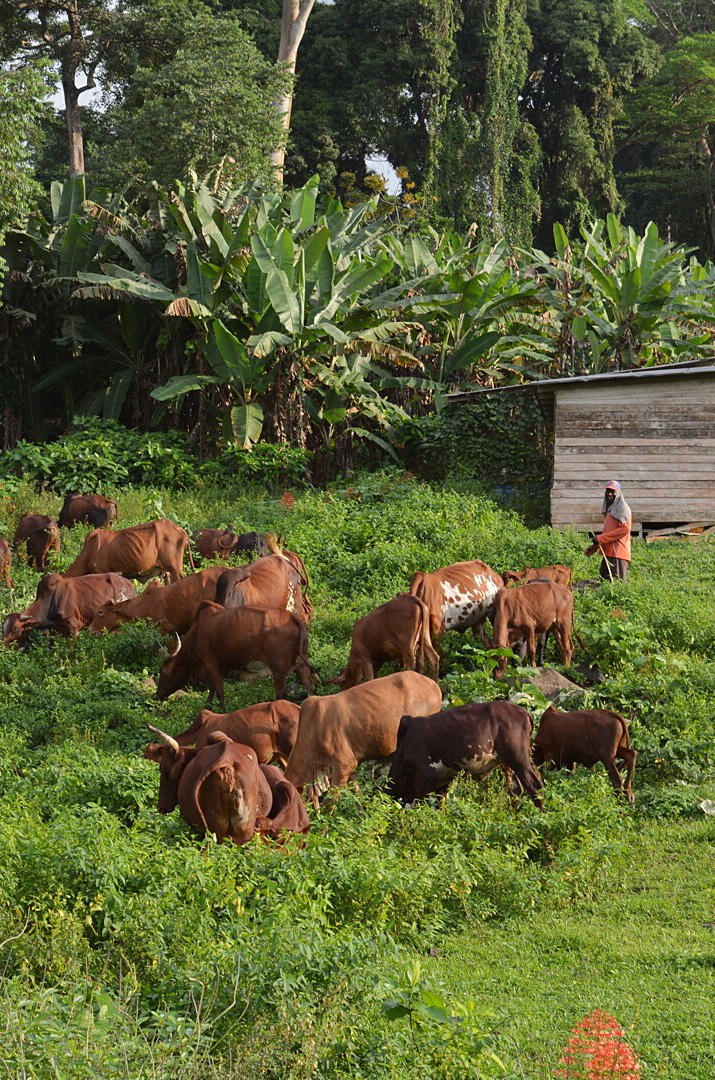
Are you interested in learning more about Equatorial Guinea? Whether you’re heading to EG for travel or just curious to know more about one of Africa’s most unique places, read on for 41 interesting facts about Equalorial Guinea.
1. The Mbini River is the longest river in Equatorial Guinea. It flows approximately 210 miles from the interior highlands of the mainland to the Atlantic Ocean.
2. The African forest elephant is the largest mammal in Equatorial Guinea. They are primarily found in Monte Alen National Park. Unfortunately, they are classified as critically endangered due to habitat loss and poaching for ivory.
3. The leopard is the largest predator in Equatorial Guinea.
4. China, Spain, and the United States are Equatorial Guinea’s main economic trading partners.
5. Fang is the most popular indigenous language still spoken.
6. The current president of Equatorial Guinea, Teodoro Obiang Nguema Mbasogo, has held power since 1979 and maintains a highly repressive regime.
7. The vast majority of the country’s political power is concentrated in the president’s family.

8. Elections occur, but they are neither free nor fair. The government frequently detains the opposition and cracks down on civil society.
9. The country is deeply plagued by corruption and serves as an example of a country that suffers from the resource curse.
10. Oil supports the endeavors of the president and his highly wasteful spending.
11. U.S. companies dominate the country’s oil business and much of Equatorial Guinea’s exports end up in the United States.
12. Prior to oil discovery in the 1990s, cacao, coffee, and timber exports were the primary commodities of the economy.
13. Today, the oil revenues have caused Equatorial Guinea to have the highest gross national income (GNI) per capita of all of Africa. However, this measurement is misleading as the wealth is highly concentrated with the president’s family.
14. The country has one of the highest rates of inequality in the world as measured by the Gini coefficient.
15. Tourism plays little role in the country’s economy as it is one of the least visited countries in the world. North Korea doesn’t even make it onto the list; that’s how few visitors we’re talking.
16. The country has undergone international isolationism as part of the rise of the dictatorial family.

17. Equatorial Guinea was colonized by several European countries. First European contact came from the Portuguese in 1472.
18. Early efforts to develop sugarcane plantations largely failed given the extreme humidity, rainfall, and temperature fluctuations.
19. Centuries later, the Portuguese and Spain signed a treaty that transferred the colony to Spanish control.
20. For several decades in the 19th century, Spain leased the territory to the British.
21. Independence finally came in 1968 after centuries of exploitation, disease, and the alienation of some native groups while privileging others.
22. As a result of Spanish colonialism, Equatorial Guinea is the only Spanish speaking country in Africa.


23. The country is composed of a relatively small territory on mainland Africa and several islands.
24. The largest island, Bioko, is home to the capital Malabo and the largest share of the country’s population.
25. Bioko is actually much closer to Cameroon than mainland Equatorial Guinea, referred to as Río Muni.
26, Bioko also contains Pico Basilé (one of the tallest volcanos in Africa) and Ureka (the wettest place in Africa).
27. Given the wide range of climates for such a tiny country, it is very ecologically diverse. Everything from chimpanzees to the highly coveted pangolin can be found here.

28. The beach at Ureka is also one of the only places on earth where leatherback sea turtles lay their eggs.
29. Equatorial Guinea shares land borders with Cameroon to the north and Gabon to the east and south
30. The largest earthquake recorded near Equatorial Guinea occurred on December 19, 2019, with a magnitude of 5.5.
31. Equatorial Guinea’s first Olympic appearance was in the 1984 summer Olympics.
32. Equatorial Guinea has never won an Olympic medal and has not participated in the Winter Olympics.
33. Eric “the Eel” Moussambani gained international attention at the 2000 Sydney Olympics for his slow but determined swim in the 100m freestyle, despite having only learned to swim months before the Games.
34. Emilio Nsue, although born in Spain, is a professional footballer who has played in top European leagues and captains the Equatorial Guinea national team.
35. Hijas del Sol is a musical duo of two women from Equatorial Guinea, known for their Afro-Latin music and activism.

36. Cassava, yams, plantains, and seafood are commonly eaten foods.
37. The Bioko drill monkey is a subspecies of the drill monkey found exclusively on Bioko Island.
38. On average, Bioko receives 79 to 138 inches (3,500 millimeters) of rainfall annually. For comparison, Seattle, WA averages 40 inches per year.
39. Bioko Island is volcanic in origin, and its highest peak (Pico Basile) reaches 9,879 feet (just over 3,000 meters). For comparison, this is shorter than most of the well-known peaks in California’s Sierra Nevadas.
40. Bioko was known as Fernando Po during colonial times, named after the Spanish explorer who “discovered” it.
41. The Bubi people are indigenous to Bioko. They are one of the largest ethnic groups.
Heading to Equatorial Guinea?
Follow on Instagram

This site contains affiliate links that send a small referral commission to me when you book. This supports the writing of helpful guides on this blog. They incur no additional cost to you.
Leave a Reply